• Skip to primary navigation
  • Skip to main content
  • Skip to footer
South Asian Network

South Asian Network

JOIN OUR E-MAIL LIST DONATEEXIT
  • About
    • Mission & Vision
    • Our History
    • Our People
    • LA Office
    • Partners & Allies
    • Funders & Supporters
  • Programs & Services
    • AWAZ: Voices Against Violence
    • CHAI: Community Health Action Initiative
    • CCE: Citizenship & Civic Engagement
    • EMH: Emotional & Mental Health
    • SMALL BUSINESS PROGRAM
    • SAN YOUTH PROGRAM
    • REQUEST A SERVICE
  • Resources
  • Media
    • Blog
    • Impact Stories
    • In the News
    • Press Contacts
    • Newsletters
      • 2026 Newsletters
      • 2025 Newsletters
      • 2024 Newsletters
  • Gallery
  • Events
  • Engage
    • Events
    • REQUEST A SERVICE
    • Donate
    • Contact Us
    • Work with Us
    • Volunteer
  • REPORTS
    • ANNUAL REPORTS
      • 2025 ANNUAL REPORT
      • 2024 ANNUAL REPORT
      • 2023 ANNUAL REPORT
      • 2022 ANNUAL REPORT
    • SMALL BUSINESS RESEARCH REPORT
    • COVID-19 RECOVERY REPORT
    • National CAPACD South Asian Financial Security Report

South Asian Network

The Parallels in our Freedom

March 1, 2022 by South Asian Network

BY CYNTHIA CHOCKALINGAM, CIVIL RIGHTS UNIT INTERN AT SAN

When I was—probably—around 10 years old, I learned at Chinmaya Mission—a Hindu Sunday School system—that when I walk around with scissors, the blade should be facing myself so no one else is at risk. We learned of self-sacrifice and valuing others; an innocent person should not suffer for the mistakes of others. But what about when they are not just an innocent person? Even before India’s fight for independence from the British, Black Americans were already fighting for freedom from the oppression they still face. Both conversations alike stress the importance of nonviolence from Mahatma Gandhi to Martin Luther King Jr. However, these conversations fail to include the importance of violence and nonviolence working side-by-side. At Black Lives Matter’s peak during the summer of 2020, many South Asians jumped to the side of white Americans in chastising the entire movement for the violence of some. Just as during the initial civil rights movement and the more recent Black Lives Matter movement—both of which are ongoing, South Asia’s fight for independence from Britain involved both civil disobedience and violence. 

India’s vision for independence began in 1857 with the rebellion uprising, which was later referred to as the First War of Independence. India itself learned that staying peaceful and moderate with no force did not lead to change. Gopal Krishna Gokhale, Congress President as of 1905 and one of Gandhi’s mentors, initially opposed what he called “extremists” like Bal Gangadhar Tilak, an early member of Congress who gained support in the 1890s. Tilak then spent the following decades cooling down towards Gokhale’s more “moderate” views. However, they soon learned this led India nowhere. Even when India greatly supported Britain during World War I, India was not granted any further autonomy. 

Understanding the fight for independence through key figures Bhagat Singh and Subhas Chandra Bose helps grasp the role violence played in India’s fight for independence. Born in 1907 to a Sikh family in modern Pakistan, Bhagat Singh was born into the fight for independence; when he was born, his father was in jail for political agitation. His father was a supporter of Gandhi, so Singh fell into this non-violent crusade, but in college, he came to believe armed conflict was the only way to political freedom. 

In April of 1929, he and his colleague—Batukeshwar Dutt—bombed the Legislative Assembly in Delhi to scare, not kill, as a result of the Public Safety Bill. After being arrested, he used the courtroom as a way to spread his political beliefs—rather than defend himself—so he was sentenced to life in prison. While investigating, Singh was connected to an earlier killing of Officer Saunders, so Singh was sentenced to death and hung. While he died at age 23, his life and actions became inspiration for many to come. 

Like Singh, Subhas Chandra Bose was a controversial figure, yet, also like Singh, he was extremely significant. While he was initially a supporter of Gandhi, he became more critical of his “less confrontational approach toward independence.” Leaving India in 1941, he travelled seeking Indian support for a forceful fight against the British. He appealed to Japan, receiving military support to take back to India. While he and his new crew were forced to retreat and he then died—which is rumored to be caused by a plane crash over Taiwan but is unconfirmed—he opened much of India and the government’s eyes to the hits they could make to the British forces. He was integral to forming the liberation army identity of the Indian National Army, and he became an inspiration for the independence movement. 

The Civil Rights Movement in America was fundamentally about freedom. Malcom X articulated that the center of this movement was identity, integrity, and independence. His philosophy was for Black Americans to protect themselves from white aggressors “by any means necessary.” Even Martin Luther King, Jr stated that Malcolm X “had the great ability to put his finger on the existence and root of the problem.” Nonetheless, the importance of non-violence cannot be undermined. They have been critical in both independence movements, both that of India and Black Americans. However, South Asians should not misrepresent our own history: it was not that purely of non-violence and success did not come from non-violence alone. Instead, we should understand this violence and force comes from a place of suffering; violent and non-violent actions together is what made India’s freedom possible. As Black History Month comes to an end, that does not mean it is time for everyone to go back to turning a blind eye to Black people’s suffering. Conversations of discrimination and inequality should continue afterwards for the rest of the year, even—and especially—in South Asian spaces. Black Americans should not be expected to keep sitting back waiting for this nation to treat them as equals. 
Additional reading

https://www.independent.co.uk/world/the-forgotten-violence-that-helped-india-break-free-from-colonial-rule-a7409066.html

BACK TO OUR PEOPLE BACK TO BLOG BACK TO OUR STORIES

Community Organization Spotlight: South Asian Network (SAN)

February 24, 2022 by South Asian Network

APASA Spotlight

PART III OF APASA’S COMMUNITY ROAD MAP, HEADED BY OUR EXTERNAL COMMUNITY CHAIR, MINAH YANG

Hello! Welcome back to APASA’s Community Roadmap, an initiative where we spotlight an organization that serves the APIDA community and hear more about their mission and how we can get involved. This month, we are taking a stop at the South Asian Network, a nonprofit organization dedicated to providing culturally and linguistically specific services and advocating for the South Asian community in Southern California. 

Thank you so much to Hina Ahmad, the Program Manager at SAN for taking the time to speak with me about SAN’s history and the amazing services they provide for their community. 

https://messaging-custom-newsletters.nytimes.com/template/oakv2?campaign_id=49&emc=edit_ca_20220323&instance_id=56468&nl=california-today&productCode=CA&regi_id=60803198&segment_id=86286&te=1&uri=nyt%3A%2F%2Fnewsletter%2Fa57833f2-24d2-5c44-a297-9b0d0925c65a&user_id=60d24373a86991a50f4c0ec8cea0910b

You can watch the interview above or read the transcript below:

How and why was the South Asian Network first founded? 

We were founded in 1990, and we really came about because there was a need for advocacy and orientation for the South Asian community. We saw that there was no organization serving the South Asian community that could speak South Asian languages: Hindi, or Urdu, Punjabi. And there was a need, there were domestic violence cases, but no one was there to address it. And 1990 is when there was a huge migration of South Asians to the nation to California specifically. And so we wanted to create some routes for South Asians to go to, to connect with other community members and to get the services that they need.

What have been the main challenges the South Asian Network has faced while trying to meet the needs of the South Asian community here in Southern California? 

That’s a difficult question. Because we do so much, we do domestic violence, sexual assault, human trafficking, case management. Since the pandemic started, we’ve definitely seen an increase in those cases, folks are stuck in their homes, they no longer have school or work to kind of go to as a place of refuge. We realized that we don’t have enough case managers that were trusted, and community members want to come to us and we want to be able to serve them in more South Asian languages than our staff has. We also do a lot of COVID education and outreach. So we’ve been doing clinics in gurdwaras, masjids, places like that. But just like every other community, in the beginning, there was a lot of misinformation about the vaccine and the side effects. So we were really pushing that work, letting folks know that it’s safe, it’s a lot better to get it than to not get COVID and dealing with that and being hospitalized. We were doing a lot of that footwork, doing cold outreach on the streets, going to businesses, and letting folks know that it’s important to get vaccinated and to stay safe and vigilant. And then I’d say one of the difficult things in the beginning of the pandemic as well was technology. A lot of our clients are older adults not used to what we’re doing now on Zoom, so providing them assistance through Zoom and over the phone is just not what what they were used to, because before they’d be able to come in and we’d be able to read mail for them, assess them face to face in their language, maybe give them some chai and some tea, just make them feel comfortable. Whereas now I kind of feel like it’s a colder conversation. But we opened the office pretty early, so community members are now able to come in and we can assist them in person.

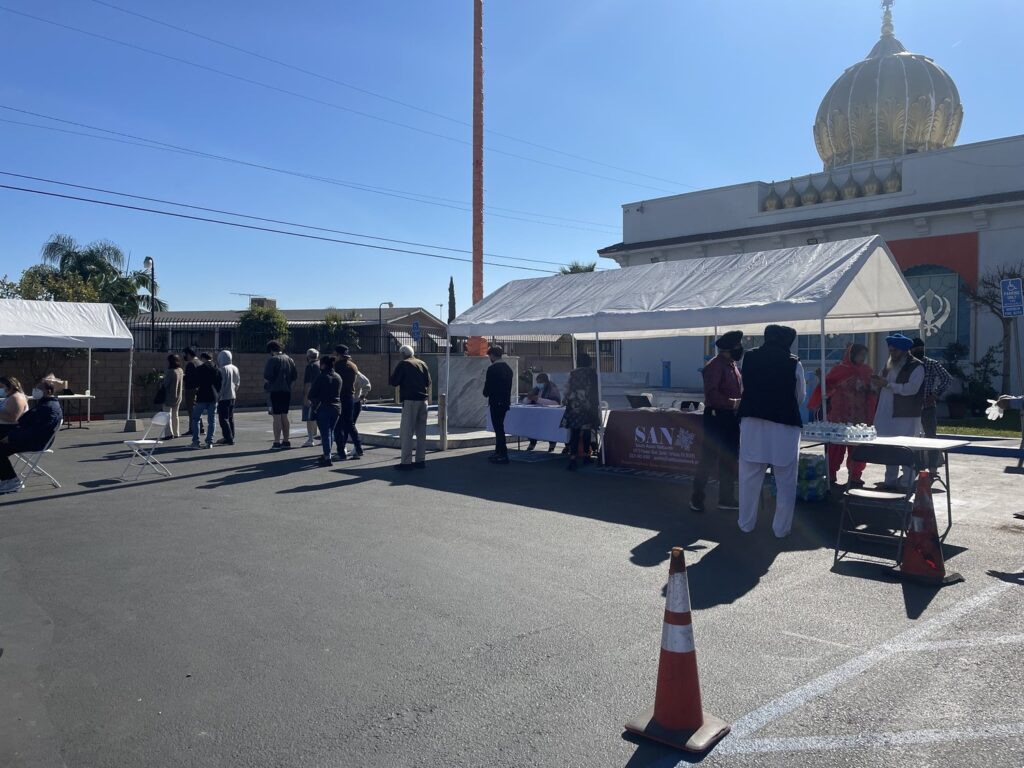
South Asian Network’s vaccination & legal clinic at Buena Park’s Gurdwara Singh Sabha.

How has the COVID-19 pandemic affected SAN’s programming?

It’s been difficult. We went through a transition in the pandemic and the Executive Director left, we got a new one, you know, a lot of staff left due to their home situations and needing to take care of their children. So this was really a rebirth for us at SAN, we’ve grown our team from four to twelve. We were doing everything. We had a server in the office that we could only utilize in the office, so when the pandemic started, we switched to Google Drive. Now we’re back in the office and just updating our phone systems or computers, everything like that. Like I mentioned before, folks want to do things in person, or in their language, and we just didn’t have that at the start of the pandemic. But luckily, we’re open now in a safe way.

You mentioned that your team grew from four to 12. Do you think more people were trying to find ways to get involved during the pandemic and so they gravitated towards this organization? Or was it more just like you were actively looking for people to recruit? 

Yeah, I think a little bit of both, right. I mean, just from the news, we hear folks are getting out of certain industries or thinking more about what they really want to do. The new Executive Director and I both came in during the pandemic as well. We wanted to rethink what the South Asian Network was, and how we really want to work for the community. We wrote job descriptions to fit current events, and what we really need and what the community really needs. Right when we put out those applications, they just came pouring in, so I think folks just were interested in helping their community and just wanting a job with a cause and passion. 

What is one program the South Asian Network offers that you wish more people knew about?

Oh, that’s a good one. Obviously, all of our services are free, but I think we could always do more outreach about the public benefits work that we do. We provide assistance with filling out the CalFresh application, which is food assistance, CalWorks, which helps you get a job, general relief, or if you don’t have a specific immigration status, you can still apply for public benefits, especially if you’re in LA County. I think folks may not know or be scared to apply to certain government relief programs, but they’re available to us. In 2016 in that administration public charge was in effect, so folks who had green cards were hesitant to get public benefits. In 2020, that rule was reversed so folks can now get public benefits and it won’t affect their citizenship at all. But still, we have some community members who are reluctant but still need that assistance,so I think letting folks know that we provide assistance with filling out public benefits applications MediCal, CalFresh, CalWORKs. 

How is the South Asian Network looking to grow or expand in the future? 

I think there’s a lot of different routes we should be taking. I think one is just on the communications front. Like I mentioned, we’ve been here since 1990, so that’s 30 years of experience, trust, knowledge. But I think our digital footprint isn’t where it should be. I feel that we should be really utilizing social media more than we are. We hired some comms staff, so I’m very excited to get that work going. Also our civil rights work, what we were founded on is the civil rights work and workers’ rights and things like that. I think over the years, we’ve kind of been focusing on domestic violence work, which is great, but I think now that our staff number is getting bigger, we can start doing that civil rights work again. 2022 is a really important year, because it’s an election year, so we really want to start doing our GOTV work and getting folks registered to vote, but also at this time, we want to start doing some anti-Asian hate work. Election season is when people get nasty and we want to make sure that folks are equipped, that they have bystander intervention training, self defense, and things like that, we want to bring that into the community. So I think we’re going to be focusing a lot more on building up our Civil Rights unit.

What are some ways that people interested in the South Asian Network’s mission can get involved? 

I think we still have a couple of job openings on our website, but we’re always looking for interns or volunteers to help us out in the office. We’re always looking for volunteers and interns for every unit: the Civil Rights unit, the mental health unit, our domestic violence unit, citizenship, etc. What we do is we have an intro meeting where we talk about what your interests are, and then we place you with the specific staff member who does that work. We want it to be a mutually beneficial relationship. So folks who are more interested in immigration, for example, they could volunteer and do citizenship applications. We would base it off your interest. You could go on our website, sign up to be a volunteer, and then we’ll reach out to you from there

BACK TO OUR PEOPLE BACK TO BLOG BACK TO OUR STORIES

Where did the Gravity of our Gratitude Go?: The Contributions of Black Americans to South Asians

February 1, 2022 by South Asian Network

BY CYNTHIA CHOCKALINGAM, CIVIL RIGHTS UNIT INTERN AT SAN

One thing I am proud of in my South Asian culture is the idea of gratitude: the South Asian culture strongly pushes to be thankful and pay people back when they help you. This starts with something as simple as when someone lends you a dish, you always send it back filled with food; if someone has invited you into their home, you never go empty handed. Yet, as we have recognized the anti-blackness in the South Asian community, I am left with the question: why have we not shown the same gratitude here? 

The South Asian community in this nation was built off of the struggles and hard work of the Black community. They have fought for our immigrants and for those back in South Asia; they have inspired movements in both areas, such as with the Dalit Panthers that expanded throughout India. With that, it is not just enough to eradicate anti-Blackness in South Asian communities; we should be crediting Black communities for all they have done for us. Our privilege along with the work other minority communities have done is what has allowed Indian immigrants to be the second-largest immigrant group in the country. 

Our overlapping history goes long and far. A few South Asians migrated in the late 1800s, but a substantive number did not arrive for much longer. Why? A couple decades later, South Asians were banned. The Immigration Act of 1917 banned a multitude of people: Asian, Mexican, Mediterranean, poor, political radical, and disabled people. On top of this, the Johnson-Reed Act was passed in 1924, which limited

immigrants through a “national origins quota” dictating only 2% of the 1890 census could be provided immigration visas of that nation. This act was not imposed on western nations and effectively banned Arabs and Asians, including Indians. During this time of passing blatantly racist legislation, Black people born in America were also being denied full citizenship, including the right to vote; this marked the start of the civil rights movement, which came into full force in the 1950s and 60s. As the Black population advocated for the Civil Rights Act of 1964 and the Voting Rights Act of 1965, they soon also pushed through the Immigration and Nationality Act—passed October 3, 1965–which repealed federal quota based immigration. 

The civil rights movement in it of itself was imperative to South Asians already in the nation. For this, we look at the 1923 Supreme Court case of United States v. Bharathiya Singh Thind. Because he was not a “white person,” he was denied citizenship. Thind was not just any normal immigrant either; he had also fought for the United States in the First World War. Vaishno Das Bagai committed suicide in 1928 after the citizenship he was granted in the United States in 1921 was stripped just two years later. The struggle of Thind and Bagai affected the entire South Asian community. The Exclusion Act in the early 1900s prevented most immigration from China, causing North American employers to look elsewhere for cheap labor; they landed in India. A “strong man” from India could make just $2 a day. 

Black communities in America have been championing support for India from across the globe. Numerous Black activists from the United States have credited India’s non-violence—ahimsa—for their methodology, always making sure we get credit where it is due, as opposed to white America, known for stealing others’ cultures, including our

own. Bayard Rustin took this a step further in 1945 when he organized the FOR’s Free India Committee, which supported India’s fight for independence from Great Britain. When Black Americans have supported us from across the world, there is no reason to ignore their suffering when we share a yard. 

Even though a reason should not be necessary to support those who are targeted and oppressed by the government, the South Asian community has multiple reasons to stand behind the Black community. When they have supported us and fought for us for decades, it is not right of us to stand back. Let’s take the gratitude we make sure to show each other, and share it with those around us—those who have given to us expecting nothing in return.

BACK TO OUR PEOPLE BACK TO BLOG BACK TO OUR STORIES

Understanding Anti-Blackness in American South Asian Communities

February 1, 2022 by South Asian Network

BY CYNTHIA CHOCKALINGAM, CIVIL RIGHTS UNIT INTERN AT SAN

During the summer of 2020, the height of this “modern” Black Lives Matter movement, I had a conversation with my father—sitting in a car driving through Hammond, Indiana to see what had happened to our old, predominantly black and brown community—that started out with: “Appa, I do not understand South Asians can be against Black Lives Matter. The work of Black Americans is integral to why we can even be here today.” We went on for a while brainstorming as to why so many members of our South Asian community were still not strong supporters of this movement. We only found one solution; many of us never learned what made it possible for us to be in this nation today and are uneducated on Black struggles. 

Members of the South Asian community counter that Black Americans do not work as hard as us, which is why South Asians appear to be more successful and suffer less. However, this overlooks the difference in histories of migration between the two groups. Anti-Blackness in the South Asian community here in America is rooted in a lack of education and a lack of empathy. This month South Asian Network will be focusing on Black Lives Matter and Black History. Before looking at how the Black community contributed and helped our South Asian community, it is important to understand how the Black experience has been different from our own. While a fight for equality should never even have to be justified, we at South Asian Network recognize this unjust treatment and recognize that some of this hatred and racism comes from our own community. As a result, we are using our voices here in hopes that our people will be strong and whole-hearted supporters of Black communities and Black Lives Matter. 

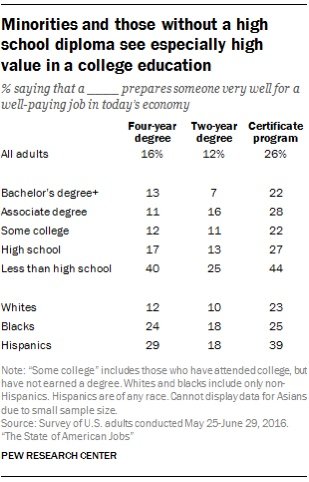
Now, we come back to why South Asians, as well as many other minorities, are not empathetic of Black people: they believe that as minorities, we all struggle alike, but unlike Black people, we are much more successful because we work harder. This in itself contains multiple misconceptions. Ultimately, we—South Asians—have not had the same history as Black Americans. The Pew Research Center explains that 69% of Asian Americans say people can just “get ahead if they are willing to work hard,” thus making them blind to the struggles of others. Privileged people tell Black people, “Get a job!” so they can be successful. Unfortunately, a disproportionate amount of Black people do not have the luxury of just getting a high paying job—not even a rich job, just one to keep their families well-supported. However, many traditional high paying jobs (traditional meaning do not require someone to take a gamble with their entire life and savings or do not need to be heavily financed with investments, like a generous donation from one’s parents) require college degrees. In fact, the SEED Foundation explains that since the Great Recession, 4.6 million jobs created have required a bachelor’s degree while only 800,000 require a high school diploma or less. The Black community recognizes the importance of a college education for a future; CNBC contextualizes that while 65% of Black adults say college is “very important,” only 44% of white adults give college that same value. 

Today, college costs close to $48,510 for a private institution and $21,370 for public annually. Due to historical and present redlining, many Black people, including those who were financially well-off, were forced into poorer communities or were essentially robbed. CBS corroborates that “Black families have lost out on at least $212,000 in personal wealth over the last 40 years becaue their home was readlined.” As a result, children in these communities, many Black, go to severely understaffed and underfunded schools—some even dealing with abrupt school closures like in Gary, a town near my hometown. Built 93 years ago, Roosevelt high school in Gary could have housed 4,000 students but after white-flight that left the city hurt, there are now 4,500 students in the district all together according to American School & University Magazine. The state of this city is and its school district is depicted in a popular Vice documentary. In it, they explain Gary has come down to pretty much just 2 functioning high schools. When Black people have been pushed to communities like these, have limited educations that decrease the chances of admission into good colleges along with necessary financial aid, are subsequently unable to get competitive jobs, how can they be blamed for the hole white people and the government has put them in? While redlining has been made illegal, single-family zoning laws still keep those with less money from well-funded schools in wealthy communities. 

How does this contrast with the stereotypical successful Asian? Asians had a different migration process that led us to not be catapulted into the same cycle of poverty. The Pew Research Center recounts that, “Large-scale immigration from Asia did not take off until the passage of the landmark Immigration and Nationality Act of 1965.” After which significantly more Asian immigrants came skilled and educated. They continue, “Today, recent arrivals from Asia are nearly twice as likely as those who came three decades ago to have a college degree, and many go into high-paying fields such as science, engineering, medicine and finance.” If we were to forget for a moment that this Asian view of hard work and success was highly stereotypical and generalized about ourselves, the people this generalization is based on came to this nation already educated; they were ready to work in high paying fields. As a result, they were able to move to nice communities with good schools. They have now set up their families for generations to come by putting them in a good place for their children to go to college, their children will get good jobs to fund their own children’s educations, and the cycle continues. 

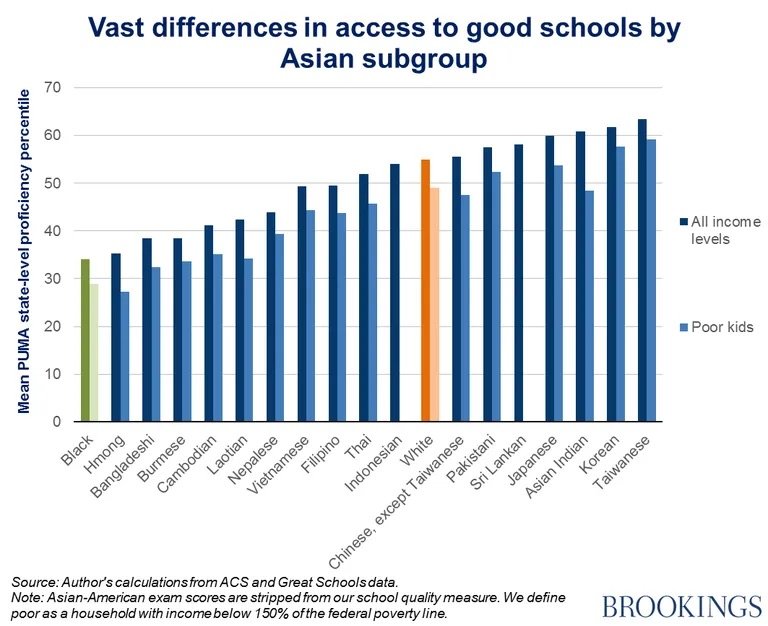
Asian success is also not determined by race, but rather income. Take Cambodians and Hmong, who have some of the highest poverty rates among Asians: they perform similarly to African American students in school. The Brookings Institute explains, “The Asian groups faring poorly are those living in areas with poorer quality schools—similar, in fact, to those in which African Americans live.” 

Yet, we as South Asians and Asians continue to stereotype ourselves, as many of us here do have the privilege of coming into wealthier professions and communities. We credit our success to our race; in reality, it is due to this economic privilege. By making these generalizations, we not only undermine Black people, but also our own underprivileged, struggling South Asian communities. Rather than shaming Black people, we could be fighting as a community for better education for all. That better education is what helps all people of this nation alike to succeed in our futures. 

Ultimately, South Asians and Asians views of success and their ties to race have caused harm to the Asian and Black communities. We understand now that this generation success is highly based on economic status and the opportunities provided through this status. While we recognize that stereotypes and generalizations were employed in the writing of this article, in no way are we implying that this is the experience of all. We recognize that money is not the only factor, not all Black people are poor, and not all Asians have experiences and privilege better than all Black people. What we did today was move through the generalizations that the Asian community has been using to stay prejudiced against Black people. By operating within these generalizations, we were able to attempt to dismantle the reasoning used to stay prejudiced against Black people, as they are rooted in many assumptions and hasty generalizations. While Black-Asian solidarity may not completely exist in the status quo, we must attempt to create it because the Black community is one of the reasons we as South Asians can be here today, thriving. As a result, our next article will be on the Black contributions to the South Asian community. 

BACK TO OUR PEOPLE BACK TO BLOG BACK TO OUR STORIES

South Asian Network Hosts Covid Vaccination & Legal Clinic at Buena Park Gurdwara

January 30, 2022 by South Asian Network

South Asian Network

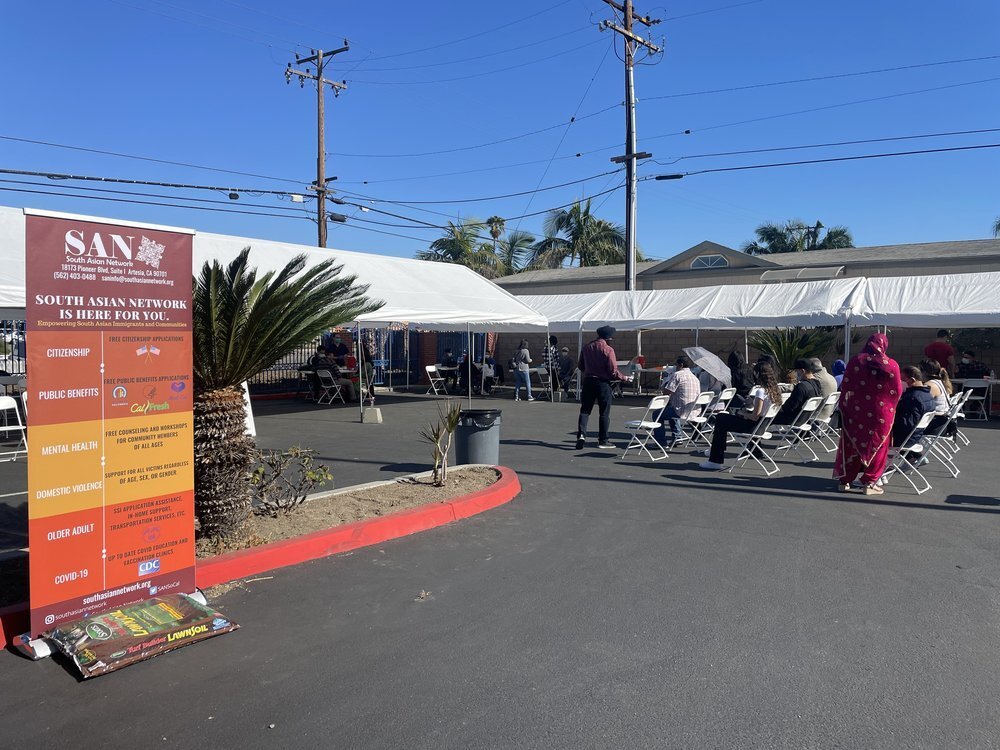
After successfully assisting almost 400 people with getting vaccinated a fortnight ago, SAN returned to Buena Park’s Gurdwara Singh Sabha on Sunday, January 30th, in its continued effort to help people get immunized against COVID-19. 

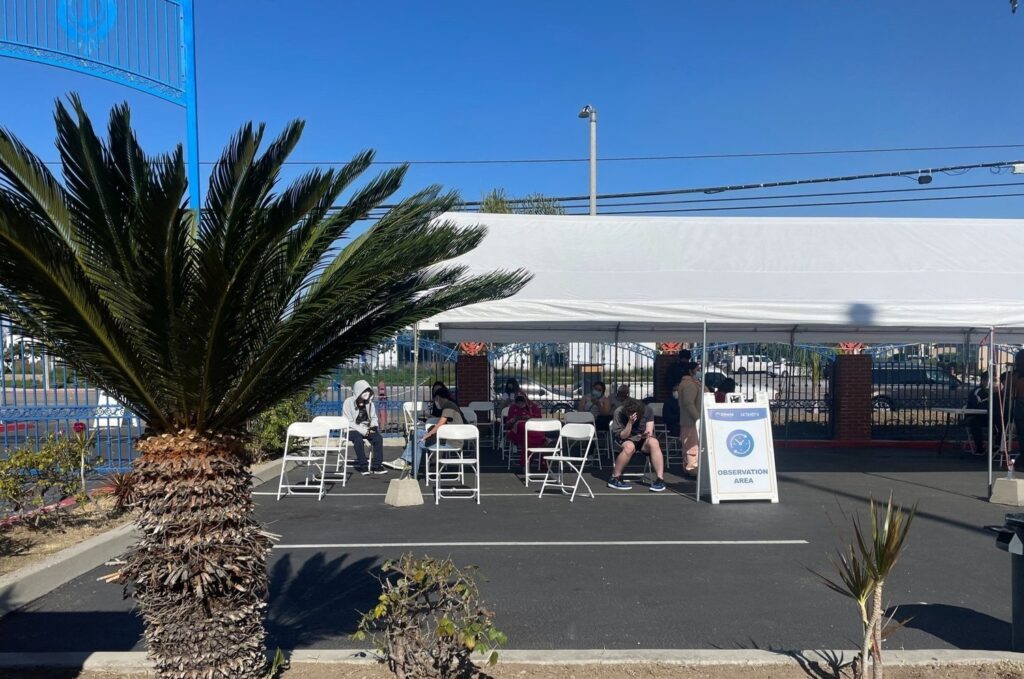
The event was a symbiotic effort between the Buena Park Gurdwara, South Asian Network and Orange County Health Care Agency and welcomed walk-in attendees along with those that had pre-registered appointments. Three booths set up with pharmacists administrating doses for adults and children ensured a minimal wait time and all of the shots (1st/2nd/booster) were made accessible.

Surjeet Singh’s family of three all received their 1st COVID-19 shot and were very happy with their experience. “Everything has been so smooth, and very nicely arranged. The staff has been very co-operative and helped us to feel at ease.

SAN’s Executive Director Shakeel Syed was overjoyed to witness that the event not only attracted Sikhs & members of the South Asian community, but even the residents of the Buena Park neighborhood. “You notice around here a sense of serving the community irrespective of one’s faith, ethnicity,

language and age. That spirit is what South Asian Network tries to foster – that we need to transcend our own traditions for the common and greater good of the society”, he said.

Programs Manager Hina Ahmad expressed that education and outreach within the community on COVID-19 has been a rocky road but the event was “very much like them welcoming us and saying yes, we believe in the science, we believe that we need to get vaccinated.”

The event also welcomed members of the community with green cards interested in applying for American citizenship. Programs Assistant Shakuntala Chugani eagerly helped those interested to make an appointment for further case-specific assistance. For the benefit of citizenship applicants with limited proficiency of English language, Community Outreach Coordinator Balvinder Kaur translated the citizenship application and interview flashcards in Punjabi. 

“It takes a village to serve the community”, Shakeel said, and the success of the event was a true reflection of that.

BACK TO OUR PEOPLE BACK TO BLOG BACK TO OUR STORIES

Story of South Asians in Southern California

January 27, 2022 by South Asian Network

South Asian Network

Manju Kulkarni

Manju Kulkarni is the co-founder of nonprofit Stop AAPI Hate, which aims at targeting discrimination in the US that affects Asian Americans and Pacific Islanders. She currently serves as the Executive Director at AAPI (Asian-American Pacific Islander) Equity Alliance, a coalition of organizations working for the rights of the AAPI community.

Named alongside colleagues and Stop AAPI Hate co-founders Russell Jeung and Cynthia Choi on TIME‘s ‘Icons’, Kulkarni has campaigned for racial equality for over two decades. She is a senior attorney and legal researcher based in California.

Stop AAPI Hate is founded in the wake of the COVID-19 pandemic that spurred a series of racist attacks against Asians in the US, served as an “invaluable resource for the public to understand the realities of anti-Asian racism, but also a major platform for finding community-based solutions to combat hate.”

In a turbulent year, as the U.S. has seen a surge in racist, anti-Asian attacks—from terrifying assaults on senior citizens to the tragic mass shooting in Atlanta—no coalition has been more impactful in raising awareness of this violence than Stop AAPI Hate. Since its start, the organization has logged more than 9,000 anti-Asian acts of hate, harassment, discrimination and assault across the country

Stop AAPI Hate has become not only an invaluable resource for the public to understand the realities of anti-Asian racism, but also a major platform for finding community-based solutions to combat hate. And its leaders have locked arms with other BIPOC organizations to find restorative justice measures so that civil rights—for all vulnerable groups—receive the protection they deserve. 

An alumna of the Boston and Duke Universities, Kulkarni has been recognized by the White House for her efforts in social work, with a focus on health for South Asian communities. She was hailed as a ‘Champion of Change’ in 2014 under then-President Barack Obama’s healthcare act.

She was the former Executive Director of the South Asian Network (SAN) organization, committed to resource access and empowerment for different racial groups.

Kulkarni, an active voice on social media, has spoken against the use of “minority” and “majority” as a descriptor for communities of people of color and is known to have said, “my identity is NOT based upon my relative percentage of the population.” 

Manju received a Bachelor of Arts degree in Political Science and a Certificate in Women’s Studies from Duke University and a Juris Doctor degree from Boston University School of Law.  After graduating from college, she worked at the Southern Poverty Law Center and the Attorney General’s Office in her hometown of Montgomery, Alabama.  While in law school, Manju clerked at the American Civil Liberties Union (ACLU), the Mexican American Legal Defense and Education Fund (MALDEF) and the U.S. Attorney’s Office in Los Angeles, California.   Manju reflects, “At the Southern Poverty Law Center, she conducted legal research to challenge district-wide voting to dilute the black vote in Alabama; at the ACLU, she sought redress for Japanese Latin Americans abducted by the U.S. government during WWII; and at MALDEF, she helped to craft legal arguments to secure in-state tuition for undocumented students.  The opportunities she had at SPLC, the ACLU, and MALDEF cemented her desire to pursue public interest law and specifically to work in the realm of civil rights.”

She asserts that the choice that most defines the woman she is today is her decision to pursue public interest law.  “Pursuing public interest law enabled me to continue working as a lawyer when my children were young, allowed me to work on issues about which I was passionate and offered a number of leadership opportunities not readily available to women in other parts of the legal world.  In my experience, public interest law firms and non-profit organizations have generally had more reasonable work requirements than law firms, requiring only forty hours a week rather than the sixty or so expected at private firms.  

Additionally, public interest firms often allowed part-time work and offered generous parental leave; law firms frowned upon reduced hours or maternity leave beyond a few weeks.  For that reason, many of my female friends and colleagues at law firms left their jobs and often their careers in the law after having a child.  I was fortunate to continue working as an attorney after the birth of both my children.  Upon the birth of my first child, I took off three months, working full-time, but only 40 hours a week, afterward.  After my second child was born, I managed to secure six months off, after which I moved to a 70% schedule, working less than 30 hours per week, 5-6 hours per day.  Moreover, my time off and subsequent schedule change had no impact on my ability to advance within the organization.  Within a few years, I was promoted from Staff Attorney to Senior Attorney alongside my colleagues who had worked full-time while I was working part-time.  Working in the public interest realm also enabled me to work in the areas of law about which I am passionate—to advance civil rights and to work to eliminate [some of the adverse consequences of] poverty.  I have been fortunate enough that my work has had impact—sometimes substantial.  In one instance, a single line I strongly recommended be changed in state health care regulations allowed fifty thousand children in California to obtain health insurance for which they previously did not qualify.  

Finally, the opportunities for success in public interest law were more numerous than in corporate law firms.  In public interest law, I saw other women and people of color move up the ladder in ways they would have been unable to do so on the corporate side.  In my first position upon law school graduation, I was able to advance very quickly within the Office of the Civil Rights Monitor, joining the management team while still in my twenties.  Similarly, as Senior Attorney at the National Health Law Program (NHeLP), I was able to access numerous leadership opportunities, including invitations to speak at large conferences, draft legislation at the state level and write appellate legal briefs.  One such brief, early in my career, was presented to—and ultimately persuasive in— the California Supreme Court.  

Manju offers this advice to incoming Duke women: “Be confident and speak your mind.  Like your male classmates, you are bright, intelligent and fully capable of meeting the challenges a Duke education will offer.  You should not be intimidated by your male peers’ bravado or swagger.  You should exude confidence in and out of the classroom.  You have a great deal to offer your college, your community, and the world!”


Uday Shendrikar

Uday Shendrikar is a retired Electrical Engineer. Uday received a Bachelor of Electrical Engineering (BSEE) degree from Osmania University, Hyderabad, India. After graduation, he worked in India for 3-4 years. 

Uday migrated to USA in late 1966 for further studies, went to Louisiana State University (LSU), and obtained a Master of Electrical Engineering (MSEE) degree. After graduation from LSU, he started working in New Orleans, went to the evening program and obtained a Master of Business Administration (MBA) degree at the University of New Orleans

Uday moved to Los Angeles area in 1973 and worked for a major Utility Company for about 25 years and started his own consulting practice thereafter. He managed and operated his consulting company for next 15 years and, in 2012, decided to call it a good time to retire.

Uday has three children, all are married and live in California. He has six grandkids and one of them will be graduating from High School by June 2022, ready to go to college in the fall 2002, waiting for notification from universities and will decide the one he likes by April 2022.

BACK TO OUR PEOPLE BACK TO BLOG BACK TO OUR STORIES

  • « Go to Previous Page
  • Page 1
  • Interim pages omitted …
  • Page 4
  • Page 5
  • Page 6
  • Page 7
  • Go to Next Page »

Footer

South Asian Network

southasiannetwork

Geared towards serving, supporting, uplifting, and educating Southern California's South Asian community

Across South Asia, many communities are celebratin Across South Asia, many communities are celebrating the arrival of spring and the beginning of a new year. 🌸🌾 From Baisakhi and Naya Barsha to Pohela Boishakh, Puthandu, Vishu, Bihu, Ugadi, Gudi Padwa, Navreh, Cheti Chand, and Aluth Avurudu, this season marks renewal, harvest, and fresh beginnings.

South Asian Network celebrates the rich diversity of traditions in our communities and wishes everyone celebrating a joyful and prosperous new year! 

Did we miss a celebration? Let us know in the comments ❤️
We’re proud to join over 40 AANHPI partner organiz We’re proud to join over 40 AANHPI partner organizations in uplifting this important community conversation.

Join us for the AANHPI California Gubernatorial Forum on Saturday, April 18th from 10:00 AM–12:00 PM at World Mission University. This nonpartisan forum creates a meaningful space for California’s gubernatorial candidates to engage directly with AANHPI communities and address the issues that matter most to our families, health, safety, and future.

📍 World Mission University
🗓 Saturday, April 18
⏰ 10:00 AM – 12:00 PM

RSVP at the link in bio / QR code on flyer.

#southasiannetwork #SAN #AANHPI #southasiancommunity #gubernatorialforum
Our Executive Director Shakeel Syed, joined partne Our Executive Director Shakeel Syed, joined partners, advocates, and community leaders in Washington, D.C. at the Supreme Court to defend birthright citizenship and the 14th Amendment.

A special thank you to @saajco for organizing and bringing advocates together for this important moment.
Organizational Statement on Gender Based Violence, Organizational Statement on Gender Based Violence, Accountability, and Community Care.
SAN on the ground at Capitol Hill. Our Executive SAN on the ground at Capitol Hill.

Our Executive Director Shakeel Syed and Deputy Director Hina Ahmad are joining partners from across the South Asian Coalition to elevate the urgent issues impacting our communities from immigration and labor rights to community safety.

Spaces like this are more than briefings, they are opportunities to challenge harmful narratives, advocate for just policies, and build power across movements.
Grateful to stand in community with organizers, advocates, and leaders committed to dignity, equity, and justice for all. 

#southasiancoalition #capitolhill #immigrantjustice #communitypower #southasiannetwork
South Asian Immigration Briefing with Congressiona South Asian Immigration Briefing with Congressional Official Jayapal & Meng by ASATA Power and the South Asian Coalition
So much love for our SAN family 💛 Thank you to ev So much love for our SAN family 💛

Thank you to everyone who came out, showed up, and made Family Night so special. From laughter to performances to all the little moments in between, we felt the community so deeply.

A special thank you to our dancers, SAN youth Sana and Anoushka, Pomona College volunteers, and Byron Lee for adding so much joy to the evening.
We’re so grateful for this community and can’t wait to see you at future events 💛
So much love for our SAN family 💛 Thank you to ev So much love for our SAN family 💛

Thank you to everyone who came out, showed up, and made Family Night so special. From laughter to performances to all the little moments in between, we felt the community so deeply.

A special thank you to our dancers, SAN youth Sana and Anoushka, Pomona College volunteers, and our magician Byron Lee for adding so much joy to the evening.

We’re so grateful for this community and can’t wait to see you at future events 💛

#southasiannetwork #familynight #southasiancommunity #nonprofit #communityevent
Eid Mubarak from all of us at South Asian Network Eid Mubarak from all of us at South Asian Network 🌙✨

Wishing you and your loved ones peace, joy, and countless blessings. May this day be filled with warmth, community, and moments that bring you closer to what matters most.
This Women’s History Month, we honor the women who This Women’s History Month, we honor the women who have shaped our lives in ways both big and small. To our ammis, dadis, nanis, didis, and all the women who have loved us, guided us, and held us through life’s many moments.

So much of our strength comes from them. From the lessons they shared to the love they gave so freely, their impact lives on in our families, our communities, and the paths we walk today.

This month, and every month, we celebrate the women who came before us and the ones who continue to inspire us every day.

#womenshistorymonth #southasiannetwork #san #southasiancommunity #southasiannonprofit
FAMILY NIGHT HAPPENING NOW 🥰🎈!! Come thru folks we FAMILY NIGHT HAPPENING NOW 🥰🎈!! Come thru folks we will be here until 8 PM!
Important benefit updates for 2026. Changes to Me Important benefit updates for 2026.

Changes to Medi-Cal and CalFresh may affect eligibility, enrollment, and work requirements. If your full-scope Medi-Cal ended in December 2025, you may still be able to restore your coverage, but you MUST  take action by March 31, 2026.

For assistance:
 📞 (866) 613-3777
 🌐 BenefitsCal.com
Visit DPSS LA County for more information and resources.

SAN is here to help as well! Call us at 562-403-0488 if you have any questions!! 

#southasiannetwork #southasiannonprofit #medicalchanges #southasiancommunity
Ek chutki sindoor ki keemat tum kya jaano, Ramesh Ek chutki sindoor ki keemat tum kya jaano, Ramesh Babu…but yummy food, games, crafts, and a whole night of community? That’s priceless 😉

Join us for SAN Family Night, bring the whole family!

March 15 | 5–8 PM
Buena Park Community Center
RSVP: tinyurl.com/sanfamilynight or click the link in our bio!! 

See you all there 🌷

#sanfamilynight #southasian #communityevent #southasiannetwork #southasiannonprofit
Earlier today, we joined legislators, advocates, a Earlier today, we joined legislators, advocates, and community partners at a press conference announcing SB 995, the Masuma Khan Justice Act, introduced by Sasha Renée Pérez.

The legislation is named in honor of Masuma Khan, a longtime community member who was detained in a private immigration detention facility despite having no criminal record. During her detention, she experienced severe conditions, including lack of access to medication, proper meals, and adequate clothing.

SAN is proud to co sponsor SB 995 and to stand alongside Masuma and her family in advocating for accountability and humane treatment in immigration detention facilities. The bill would strengthen California’s ability to inspect private detention facilities and enforce basic health, safety, and labor standards.

We remain committed to protecting the rights, dignity, and safety of immigrant communities.

First slide photos by: @ericanders 

#SB995 #MasumaKhanJusticeAct #ImmigrantJustice #SouthAsianNetwork #CommunityAdvocacy
Before the organizing, the advocacy, the programs, Before the organizing, the advocacy, the programs, and the long days of showing up for our community… there were these photos. 💛

Today for Employee Appreciation Day, we’re celebrating the incredible humans behind the work at South Asian Network. From connecting families to resources, to advocating for justice, to creating spaces for healing and empowerment, this team makes it all possible 🌷

We’re grateful for the heart, dedication, and care each person brings to our community every day. (And yes, they were all adorable back then too🥹)

#southasiannetwork #southasiannonprofit #employeeappreciationday #southasian
Wishing you a Holi filled with vibrant colors, lau Wishing you a Holi filled with vibrant colors, laughter, and moments that bring our community closer together. 
From all of us at SAN, may this Festival of Colors remind us of the joy that comes from celebrating one another.

Happy Holi 🌷✨
What an incredible afternoon of solidarity, courag What an incredible afternoon of solidarity, courage, and community! 💛 

On February 21, SAN, alongside @aapiequityalliance and @vietriseoc, brought our neighbors and families together to show that when we stand united, we are unstoppable.

Together, we send a clear message: we belong, we protect one another, and we move forward as one. Thank you to everyone who showed up and showed out our strength is in our solidarity. 

And this is just the beginning! We will continue fighting for justice, equity, and the safety of our communities.

A huge shoutout to our amazing dhol player @jupgonthebeat,
🥁 whose beats carried our message of care, courage, and collective power across the crowd, your rhythm reminded us all of the heartbeat of our community.

#southasiannetwork #iceoutofartesia #communityrally
#southasiansunite #communitypower
ICE OUT OF ARTESIA MARCH AND RALLY LIVE STREAM ICE OUT OF ARTESIA MARCH AND RALLY LIVE STREAM
HAPPENING TOMORROW 💥📢‼️ In partnership with @aapi HAPPENING TOMORROW 💥📢‼️

In partnership with @aapiequityalliance and @vietriseoc , South Asian Network is bringing our community together to show that solidarity is power!! 

This is a moment to show up for one another and to remind ourselves that community is built through care, courage, and collective action.
When we gather, we send a powerful message: we belong, we protect one another, and we move forward together. 

We come together to remind our families and neighbors that they are not alone and that our community stands firmly behind them. Our collective presence is an act of care, courage, and accountability.

February 21, 2026 
18173 Pioneer Blvd, Artesia, CA 90701
3:00–4:00 PM
Ramadan Mubarak from the South Asian Network! May Ramadan Mubarak from the South Asian Network!

May this month bring you peace, reflection, and spiritual growth. Wishing all those observing a blessed and fulfilling Ramadan!
 
#ramadan #southasiannetwork #southasiannonprofit #southasian #community
Follow on Instagram


18173 Pioneer Blvd., Suite “I”, Artesia, CA 90701
Phone: 562-403-0488 • E-mail: saninfo@southasiannetwork.org
Office Hours: 9 am to 5:30 pm, Monday to Friday.


Copyright © 2026 · SOUTH ASIAN NETWORK

site credits