• Skip to primary navigation
  • Skip to main content
  • Skip to footer
South Asian Network

South Asian Network

JOIN OUR E-MAIL LIST DONATEEXIT
  • About
    • Mission & Vision
    • Our History
    • Our People
    • LA Office
    • Partners & Allies
    • Funders & Supporters
  • Programs & Services
    • AWAZ: Voices Against Violence
    • CHAI: Community Health Action Initiative
    • CCE: Citizenship & Civic Engagement
    • Organizing Against Anti-Asian Hate
    • EMH: Emotional & Mental Health
    • SMALL BUSINESS PROGRAM
    • REQUEST A SERVICE
  • Resources
  • Media
    • Blog
    • Impact Stories
    • In the News
    • Press Contacts
    • Newsletters
      • 2026 Newsletters
      • 2025 Newsletters
      • 2024 Newsletters
  • Gallery
  • Events
  • Engage
    • Events
    • REQUEST A SERVICE
    • Donate
    • Contact Us
    • Work with Us
    • Volunteer
  • REPORTS
    • ANNUAL REPORTS
      • 2025 ANNUAL REPORT
      • 2024 ANNUAL REPORT
      • 2023 ANNUAL REPORT
      • 2022 ANNUAL REPORT
    • SMALL BUSINESS RESEARCH REPORT
    • COVID-19 RECOVERY REPORT
    • National CAPACD South Asian Financial Security Report

blog

Pride Month: South Asia’s Ancient Queer History into Today 

June 18, 2022 by South Asian Network

Oftentimes, it’s easy to forget how recent colonization in South Asia by Europeans ended. In reality, for many of us today, our grandparents, parents, or even ourselves lived through it. While the West was beginning to see progress towards inclusivity in the 1900s, South Asia had just been left by the queerness is provocative and unacceptable during colonization.The UK saw the beginning of organized LGBTQ+ civil rights movements in the late 1960s and early 1970s. Post-colonization, South Asia simply wanted to live up to the “standards” the west had left behind, so communities in South Asia let go of parts of its histories and cultures. As a result, many South Asian American spaces are not safe or welcoming to LGBTQ+ individuals. The world’s oldest South Asian LGBT magazine, Trikone, was not founded until 1986. 

The time of the 70s and 80s was also when there were great waves of migration from South Asia to Britain. Yet, since the very beginning, South Asians played a critical role in this movement. In 1988, the group Shakti was found, representing South Asian lesbian and gay individuals. That same year, a founding member of Shakti, DJ Ritu, also founded a club: Club Shakti. This club raised funds for the larger organization and provided a safe space for British South Asian queer people. 

However, this “progressive acceptance” that these South Asian people represented and demonstrated is not something new. I contest that accepting queer people is not “progressive” in regards to South Asian history and culture because being part of this community was once normal. Hinduism, born in ancient South Asian culture, does not condemn LGBTQ+ individuals, unlike other religions. Some Hindu scholars argue Shikhandi, in the Mahabharata, is transgender, but Krishna did not mind sharing a chariot with this warrior. Gods frequently change from one gender to another. One such example is Vishnu, who came in a female form: Mohsin.

As a Bharatanatyam dancer for fourteen years, one of my favorite pieces is Ardhanari—depicting Ardhanareeswara, a God half man/half woman, half Shiva/half Parvati. On one side, River Ganga is flowing out of Shiva’s head; on the other, Parvati’s head is decorated with a beautiful bun. On one side, Shiva has skulls hanging from his neck; on the other, a gold chain hangs from Parvati’s neck. Shiva’s ankle on one side is surrounded by snakes; Parvati’s is decorated with a beautiful anklet. More than just being half Shiva and half Parvati, Ardhanareeswara depicts that the human being is not purely “masculine” strength or “feminine” beauty; the human being must be made of a balance between strength and grace—regardless of gender. Gender does not confine one to the attributes of gender stereotypes. 

This is not all to say that queerness is a large part of Hinduism; it’s a part of South Asian history as a whole. Such “form shifting” is part of other religions of the region too. The Lotus Sutra, an Indian Buddhist scripture, tells the story of Avalokiteśvara, the bodhisattva of compassion, who is also associated with Tara, the multi-form female bodhisattva.

Even after homosexuality was made illegal, queerness was not treated as “odd” as in the west at times. For example, in the 1884 case of Queen Empress v. Khairati, Naisargi N. Dave explains in Feminist Studies that Khairati was “clearly a habitual sodomite,” the verdict that found him guilty was overturned because of a lack of precise details, such as “time, place,…other persons involved.” While gender stereotypes were certainly stronger at the time than earlier, this exemplified that even with colonization, South Asian culture is rooted in questioning these boxes and stereotypes. Source after source says that so much ancient South Asian literature and culture is permeated with queerness that it is difficult to separate and identify the queerness; it’s difficult to compile all of this queer South Asian literature because there is so much of it. 

An LGBTQ+ group that cannot be overlooked are the Hijra, an identity of intersex/trangender people, that have existed for over 2000 years. Mughal Empire Muslim leaders were patrons of Hijra. However, British colonization led to the criminalization of hijras, leading to stigma and fear despite their significance. Europeans could not fathom a third gender. This long history is a complex one with a complicated set of identities: some just call them transgender; while moreso outside India than outside the nation, this is considered by some a completely different gender—a third gender—all together because ultimately, they are not men becoming women or women becoming men or confining themselves to a box of one of the two in anyway; they are neither male nor female, but they are not transitioning to one either. This group is also known as Aravani, Aruvani, Jogappa, and Kinnar/Kinner. 

Despite the setbacks for Hijras caused by the British, they have won some protections since then. Starting in 2007, Pant v. Nepal found that third gender would be protected under the same ruling that legalized same-sex marriage. In 2013, Bangladesh legally recognized people who identified as a third gender, protecting the Hijra community. The following year, 2014, the ruling from National Legal Services Authority (NALSA) v. Union of India paved the way to legally recognizing the third gender; this also meant “sex” based protections are not exclusively for protections for biological characteristics—but also self-perceived gender identity. Today, there are over half a million Hijras in South Asia. 

(The Guardian)

Queerness that has been part of South Asian culture cannot be denied. Nonetheless, we cannot deny the homophobia and discrimination clearly present within the culture today and for many centuries past. As South Asian Americans, us young, “liberal,” and “progressive” kids often want to embrace the diversity and open-mindedness of our history and heritage; in this process, we cannot overlook the damage caused by our ancestors and our own families and friends—and ourselves—resulting in prejudice and damage towards queer South Asians and South Asian Americans today. It is not uncommon to hear uncles and aunties tell us stories of intersex and transgender gods but turn away from LGBTQ+ South Asian American individuals today. We cannot embrace the commonplace of queer South Asians as just history; we must embrace it as part of our culture that will and should exist forever. 
BACK TO OUR PEOPLE BACK TO BLOG BACK TO OUR STORIES

South Asian American Contributions to the United States and the West: A Reflection During AAPI Month of how South Asian Americans Have Been Integral to the Development and Growth of Americans’ Health and Wellness

May 30, 2022 by South Asian Network

Despite the challenges South Asian Americans face in this nation, a significant amount of Americans’ cultures contain stolen or borrowed aspects of South Asian cultures—whether it be shared through the west’s earlier colonization or South Asian immigation to the United States. Consequently, as AAPI is coming to a close, we will be reviewing aspects of American practices and cultures that are derived from South Asians and South Asian Americans. 

To the general American populace, “South Asian” and “Desi” are synonymous labels. They view our culture as just one thing: Bollywood. They are familiar with naan, paneer, Hindi, and butter chicken. When I mention I eat dosas and idlis at home everyday and I am Tamil, they have no idea what I am talking about. This educational disconnect results in failure to acknowledge many contributions from South Asia and South Asian Americans because they do not know about the multitude of cultures that originate from the entire Indian subcontinent. 

Ayurvedic, Siddha, and other traditional medicine practices from South Asia have taken rise in the United States and the western world. India welcomes students from the USA and Canada into its higher institutions to allow students from all over the world to learn and be inspired by our ancient practices and cultures—practices that many South Asian Americans have been promoting in the United States itself. Education around Ayurveda and practices themselves are very successful in many states in this country. Ayurvedic practices were introduced to the United States in the 1960s. In just more recent years, the practice has been integrated into American clinics, spas, academic centers, and oncology wards. 

The role of Ayurveda in America’s daily practices is only expected to grow. The New York Post predicts, “The ancient science of Ayurveda is beauty’s next big thing.”Ayurvedic practices are being introduced to not just hair care, but also cosmetics and skin care. Ancient South Asian practices are becoming part of normal life and daily practices in the United States because of the knowledge South Asian Americans have introduced to the United States to maintain personal and body wellness. 

I think I can safely say that most people in the United States—at least—know of the Kardashians. Well in a recent episode of The Kardashians, a new TV show centered around the Kardashians replacing Keeping Up with the Kardashians, Kourtney Kardashian and her partner, Travis Barker, had a Panchakarma cleanse—an Ayurvedic treatment—to help Kourtney with her fertility struggles. 

Protein bars have also become integral to many gym frequenters’ diets. Btein Bars are a new protein bar on the market that are expected to outperform by almost double the growth of the protein bar industry. Btein Bars boast that their health benefits are rooted in a key ingredient: Ashwagandha. Ashwagandha also finds an ancient history in Ayurvedic practices as a “healing root that helps relieve stress.” Already in Walmart and Onelavi, the bar is also soon coming to Amazon. 

Perhaps one of the most common practices derived from South Asia and South Asian Americans is hair oiling—referred to by many Americans as “hair slugging.” I remember when I was young and my mom would oil my hair and body at least once a week. Not knowing it was uncommon, I would go to school and talk about my “oil baths,” and my peers would look at me like I was crazy and it was disgusting. A little over a decade later, hair and body oiling has become common practice amongst a considerable number of Americans. NPR quantifies that, “influencer content on social media mentioning “slugging” terms saw more than a two-fold increase in the number of posts between May 2021 and April 2022, compared to the previous year, and about 600% more video views.” Hair oils and body oils are now common in everyday stores like Target and Sephora. Fable & Mane is a South Asian American owned brand that uses South Asian roots in their hair care solutions. They have been featured in American publications like Vogue, Forbes, Allure, and InStyle. Now, this brand finds itself to be used by everyday Americans all across the country. 

South Asian American doctors and scientists, such as Dr. Khushboo Garodia and Dr. Varalakshmi Yanamandra, have been integral in helping uncover the science behind this ancient practice and explaining the benefits. 

South Asian American doctors like these have paved the way for powerful South Asian American businesses that have introduced our ancient practices to modern cosmetics, providing solutions that are healthier for humans and the earth. For example, Sravya Adusumilli founded Mango People Cosmetics, which uses “elements of nature.” Adusumilli explains, “I started experimenting with clays and pigment rich fruits and flowers such as cherries and hibiscus. I researched Ayurvedic principles and its teachings of using powerful plants and herbs to heal the body, mind and spirit.” Advocating for people of color, she also explains a core tenant of her clean beauty brand is creating products that are inclusive of all skin tones while maintaining quality and performance. 

Similarly, Kulfi Beauty, founded by Priyanka Ganjoo, is well known for its Underlined Kajal Eyeliner. This brand has been featured in Allure multiple times and has gained national recognition. Kulfi Beauty is renowned for its eyeliner that was inspired by South Asian kajal eyeliner. 

South Asian Americans and our contributions have become so integral in this nation that they have just become a part of daily life, consequently, these contributions often go unacknowledged. Younger South Asian Americans often discuss the disconnect between ourselves and the older generation—whether something is cultural appropriation or appreciation. To some, seeing a white woman wearing a bindi out and about on a normal day is inappropriate and stealing from our culture, while to others, it brings joy to them to see our practices just become a part of daily life. Regardless of which way you feel, I still believe it is important to acknowledge these practices and contributions that come from South Asians and South Asian Americans. Ultimately, many of us have built our homes here for generations to come and our descendants should still have a culture to call their own and take pride in.

BACK TO OUR PEOPLE BACK TO BLOG BACK TO OUR STORIES

API Heritage Month: South Asian American Involvement in Social Movements

May 13, 2022 by South Asian Network

This month, May, is Asian American and Pacific Islander Heritage Month. As we have previously discussed, South Asians are becoming a growing part of this county’s population and history. South Asian Americans must be recognized for our contributions for many decades in this country. 

It’s important that during this month, we—as South Asians—do not forget that this heritage month includes us, as well. Oftentimes, we are told, “You’re not Asian.” Looking at a map, it is easy enough to tell that we are. However, the impacts of those statements, as wrong as they are, have consequences. South Asians, amongst Southeast Asians and Filipinos, are often not included in advocacy spaces for Asians. Kevin L. Nadal explains in “The Brown Asian American Movement: Advocating for South Asian, Southeast Asian, and Filipino American Communities,” a Harvard Kennedy School publication, that by the late-1960’s and 70’s, “Yellow Power Movement” was used as a term to replace the Asian American Movement in response to the Black Power Movement and the Brown Power Movement. This title established East Asian Americans to be the dominant voice in this movement, whether it be intentional or unintentional. Nonetheless, our advances, accomplishments, and contributions have been imperative towards the progress of this nation. 

In the early 1900s, San Francisco saw the rise of the Ghadar Party. Composed of a group of mostly hard labor workers and farmers, this group of Indian immigrants worked together to push for Indian freedom from the British while being in America. This group of South Asian Americans stood for the ideals and values of democracy. This was while they faced anti-Asian sentiments that targeted them from entering the country and caused them to face more discrimination if they made it in. As San Francisco was growing at the time, South Asian Americans certainly played a role in what San Francisco has grown into today: not just a technological hub, but a place of growth and support for American social movements. 

Staying located in San Francisco but coming to our current times, there is an organization called the Alliance of South Asians Taking Action (ASATA) that was started in 1999. They started out with responding ot human trafficking, labor exploititation, and gender-based violence. Post-9/11, they began running Know Your Rights workshops for community members if FBI agents attempted to question you. This organization also partnered with non-South Asian American organizations against racialized surveillance. In 2013, Oakland started a surveillance system called the Domain Awareness Center (DAC). This program had over 700 cameras in schools and public housing that used facial recognition software and automated license plate readers. ASATA worked with other organizations, and ultimately, the program was confined to the Port of Oakland. The use of facial recognition and license plate reading software was prohibited after this movement. The city then created Oakland’s Privacy Advisory Commission for citizens to be able to protect their own privacy; Sahiba Basrai, an ASATA member, chaired this commission. Overtime, this organization has been integral in the area to keeping the voices of people of color alive. They worked with the Asian Pacific Islander Coalition Against the War, Justice in Palestine coalition, and the SF Anti-War Coalition. 

South Asian Americans have had much to rise up from and face in this nation’s history—making our contributions all the more notable. Vivek Bald, a historian and filmmaker, explains the Bellingham Riots on September 4th of 1907 in Time Magazine that this marked the first “known incident of large-scale, organized anti-South Asian violence in the United States.” This attack was launched in Bellingham, Washington where hundreds of white workers searched the town for Indian immigrants. They attacked laborers, predominantly Punjabi Sikh men, working in Bellingham lumber mills. Their bunkhouses were set on fire, their possessions and passports were stolen from them, and they were beaten. What was the result of this attack? Congress passed the 1917 Immigration Act, banning Asian labor migrants from entering, and the Indian immigrant lumber workers in this community left, walking into Canada, in fear of their own safety. 

This is Asian American and Pacific Islander Heritage Month. Part of our South Asian American Heritage is the pain and discrimination we have suffered and the discrimination that our community was built upon. Each time I write a blog like this, I am learning something new as I am doing my research. Understanding the background our community is from here helps me understand all that we had to overcome to get here. It makes me all the more proud in embracing our heritage and how far we have come. Now, organizations like South Asian Network fight not just for ourselves, but for people in all communities in our region to live safer and more peaceful lives.

BACK TO OUR PEOPLE BACK TO BLOG BACK TO OUR STORIES

Sexual Assault Awareness Month: Resources and Educational Material Regarding Sexual Violence in the South Asian American Community

April 1, 2022 by South Asian Network

TRIGGER WARNING: SEXUAL ASSAULT AND VIOLENCE, CHILD MOLESTATIONS.

BY CYNTHIA CHOCKALINGAM, CIVIL RIGHTS UNIT INTERN AT SAN

While we at SAN want behavior, stigma, and climate to change around sexual assault in our communities, we understand that a cultural shift does not happen overnight. That is why in this blog, we will also be providing educational and helpful resources as to how to respond to sexual violence and steps we can take as a community to overcome the restraints created by sexual violence. When the community does not provide an environment to discuss sexual assault, we hope we provide you some better context and information. 

The prevalence of sexual violence in South Asian American communities can be partially overcome by starting conversations surrounding safety at a young age. We often talk in metaphors about sexual violence in our community. However, that leads us devoid of language to actually approach the issue. Parents will tell us to not go somewhere late; if asked why, maybe I would get a: “Boys will be there; that is bad.” Nothing more. Sobia S. writes about how restrictive the conversation and terminology is. She heard phrases like “the devil is the third when two are alone.” However, languages like Punjabi, Hindi, and Urdu do not have common terms of usage for anatomy because they are considered vulgar and crude profanity. Consequently, survivors cannot discuss the assault they faced and how they were violated. Sobia tells her story where as a child, she was molested by her uncle. However, she did not know how to start the conversation with her parents. Eventually, she told her mother she had been touched “down there.” Language is important, and the language we use right now is very restrictive. Opening conversation with children allows our community to be more receptive to these topics as we grow older. 

As that will take a while to develop, there are South Asian organizations that already work with the objectivity of helping South Asian American survivors, with many seeking to provide immediate assistance. In our last Sexual Assault Awareness Month Blog, we mentioned that many orgs are now working to help survivors of sexual assault within the South Asian community; the National Center on Domestic and Sexual Violence has published a list with links to different organizations that provide resources to survivors and do work in this area. Manavi has compiled a list of South Asian Domestic Violence Agencies nationwide, where even our own SAN is listed. Sakhi works with domestic violence survivors; part of their program includes a helpline. Available Monday through Friday, 10AM-10PM, you can call 1(212)868-6741 or text 1(305)204-1809. They even offer an email helpline of advocate@sakhi.org. They offer specialized help to youth between the ages of 6 and 24. As it is difficult for many young people to talk about this openly with their families, making this resource clearly available to young ones in your family could be a contact they need—have something occur. 

Saheli, an organization based in Massachusetts to support South Asian women and families, has set an example for other organizations to come. They provide culturally sensitive services to survivors. They have domestic violence advocates that speak several South Asian languages, such as Bengali, Gugurati, Hindi, Kannada, Marathi, Punjabi, Sindhi, Tamil, Telugu, Urdu, Nepali, and Arabic. They provide legal support through translation, court and police station accompaniment, and free family law legal clinics. They help survivors find a path to a better future through economic empowerment work to become educated and find a job. 

SAN’s Voices Against Violence program is quite expansive too, offering: safety planning for survivors and their children; case management and advocacy including shelter placement, court accompaniment, access to public benefits and financial literacy; counseling and emotional support for survivors and their children; access to legal assistance in the areas of family and immigration law; parenting classes; groups for young women being pressured into marriage; interpretation; community workshops to raise awareness about domestic violence and child abuse and the resources available; and prevention workshops and activities in collaboration with religious and community leaders. Ultimately, SAN wants to be here to support you where we can too. 

We know sometimes we tumble with the question: “Was I sexually assaulted?” or “Was _____ sexually assaulted?” This can be an especially difficult question in the online environment. Sexual harassment and abuse online is sending unwelcome sexual communication images/livestreams or requests. Sharing these images without consent also falls into this category. In any case, the National Sexual Assault Hotline is always available at 1(800)656-4673. If you are present in immediate danger, call 911. 

The steps to addressing sexual violence in the South Asian American community are two fold: being responsive immediately and not creating an environment that allows for sexual violence in the long run. Language has power and giving members of our community the voice they need will let us take the first step in even acknowledging the issues we have in our community. Only after this can we dismantle structures that uphold this behavior. Nonetheless, it is important to never forget that your life is not a movement; it is not your burden if you are a survivor to do anything with your story that you do not wish to. You are not obligated to publicize your story to reduce stigma in our community. Your first priority is you.

BACK TO OUR PEOPLE BACK TO BLOG BACK TO OUR STORIES

Sexual Assault Awareness Month: The Prevalence of Sexual Violence in the South Asian Community

April 1, 2022 by South Asian Network

 TRIGGER WARNING: RAPE AND SEXUAL ASSAULT

BY CYNTHIA CHOCKALINGAM, CIVIL RIGHTS UNIT INTERN AT SAN

The South Asian culture is one that has taught us to be silent in our suffering; it has taught us that there is nothing more important than being selfless. This selflessness leads us to being caught in a culture where gender and sexuality issues go almost completely unaddressed. There’s a taboo in even approaching such issues as they risk the family’s “reputation,” so girls are taught to be selfless in valuing their families over themselves. This taboo results in further suffering to victims and the relationships they have with their families and those around them. In many South Asian communities, victims are silenced and left without help. 

Even more so, members of the LGBTQ+ South Asian community face even more sexual attacks, yet they receive even less attention. A study conducted in the New York State region—-led by professors and individuals affiliated with New York University—consisting of 385 18 to 34 year-olds that are South Asian Americans quantified some disparities between these different communities. 24.1% of the surveyed individuals identified as part of the LGBTQ+ community. Members of the queer community were more likely to be raped multiple times, quantifying that 17.2% of the South Asian American queer community experienced rape multiple times—compared to 9.6% of their heterosexual counterparts. Consequentially, sexual minorities had higher odds of depression.

Nonetheless, I must acknowledge the progress the South Asian American community has made in acknowledging sexual assault within American society. Body Evidence: Intimate Violence Against South Asian Women in America is a book edited by Shamita Das Dasgupta that examines violence women face in South Asian American communities. Since the 1990s, around 25 South Asian community-based organizations have been established that are rooted in anti-domestic violence work. However, Sagarika Gami at Pomona College counters that these organizations primarily only solve individual problems while sexual violence in the South Asian American community is systemic; therefore, there must be a collective, systemic solution. Shamita Das Dasgupta argues that lots of the stigma surrounding sexual violence in South Asian American communities is heavily tied to the Model Minority Myth; I would agree with this. 

The model minority myth is a construct and a set of stereotypes framing Asians, including South Asians, as the “ideal” minority that works hard and does not challenge the status quo. The University of Texas at Austin explains that most Asian-Americans are placed into this category called “model minorities” essentially meaning they are perfect, successful, and what every minority should aim to be. The cultural expectations include being naturally “smart,” wealthy, hard-working, submissive and obedient, uncomplaining, and self-reliant. They live the “American Dream.” Vivian Biwei Huang at UCLA

✎ EditSign explains Asian American students often hide their personal problems and struggles compared to other demographics because they do not want to stray from this “good” stereotype where Asians and Asian-Americans are “perfect.” Ultimately, the myth is destructive for all parties. Many Asians and Asian Americans in the United States uphold these stereotypes and ideals out of safety and self-preservation. South Asians in this community live by keeping our heads down and staying out of the way, and we can survive. Consequently, victims of sexual violence are told to keep quiet to keep from causing disruption. While it is understandable that parents want nothing more than for their children to be able to succeed, the trauma left behind by sexual violence—especially untreated and unacknowledged trauma—prohibits many from growing and reaching their full potential. 

The number of victims in our South Asian American community is significant, and they cannot keep being ignored. The Asian Pacific Institute on Gender Based Violence helps quantify how large this problem is: “Of API women, 23% experienced some form of contact sexual violence, 10% experienced completed or attempted rape, and 21% had non-contact unwanted sexual experiences during their lifetime.” Further, “64% of Indian and Pakistani women had experienced sexual violence by an intimate in a study of 143 domestic violence survivors.” They also quantify, “50% of Indian and Pakistani abused women reported being stalked by an intimate partner.” These actions are surrounded by a culture that gives ground to violence. In fact, the institute states, “79% of South Asians…reported being hit regularly as children.” When violence is treated as normal from a young age, a South Asian woman who faces violence as an adult is less inclined to report it and prevent it from happening again. 

Concepts of “honor” and “shame” keep members of the South Asian American community from discussing situations of sexual violence—these patriarchal norms and values are prevalent in South Asian communities around the world. Consequently, as a community, we have overlooked this issue for quite some time. Despite these situations being prevalent for generations, we have been unable to address them due to the stigma surrounding these conversations; we then pay the price. Members of our own community continue to become victims with no light or solution in sight. 

BACK TO OUR PEOPLE BACK TO BLOG BACK TO OUR STORIES

INDIA: Ignorance to Intolerance Regarding Muslims in the Country

April 1, 2022 by South Asian Network

BY CYNTHIA CHOCKALINGAM, CIVIL RIGHTS UNIT INTERN AT SAN

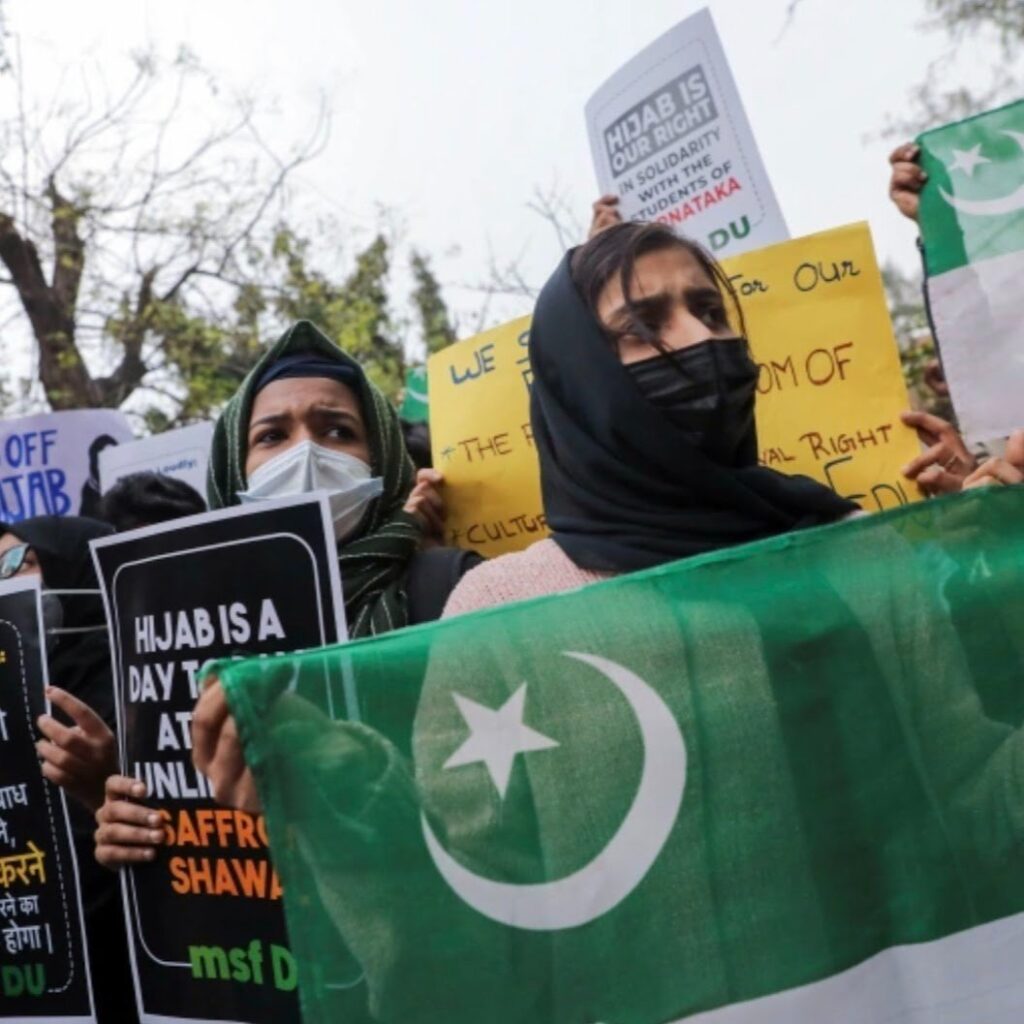
Islamaphobia Rising In India Marked By New Law In The Southern State Of Karnataka That Bans Muslim Headcovering

Muslim women in New Delhi protesting against the Hijab ban [Anushree Fadnavis/Reuters]

India is seeing rising Islamophobia as the southern state of Karnataka upholds a hijab ban in public educational settings. On February 6, 2022, the state government invoked the state law to back up the hijab ban, making the ban effective until it has been ruled on by a higher court. This has catalyzed the Hindu nationalist citizens in the state to grow violent and harass Muslim students in Karnataka that maintain their religious freedom to wear burqas or hijabs. Due to the Hindu nationalists’ dangerous reaction, Chief Minister Basavaraj Bommai declared a 3-day leave for high schools and colleges. However, both the state and national governments failed to condemn such actions. 

The headcovering ban in Karnataka marks the point where India no longer fears appearing intolerant and discriminatory. The BJP and India’s Hindu nationalist government have sent a message they prioritize their Hindu nationalism over the basic safety of their citizens. It’s egregious that Islamophobia in India has progressed to the point that people can threaten the lives of Muslims and expect no consequences in return. 

Discrimination against Muslims in education—specifically against Muslim women—has long existed. Athiya, who is currently a student at Manipal University in Karnataka explains, “Once a teacher made a hijab-wearing student sit on the floor in the middle of the class and stripped her hijab off. We faced a lot of humiliation for choosing to wear the hijab. But at that time, they did permit us inside the classroom.” Now, this discrimination is codified and legal. As Athiya alluded to, Muslim girls wearing a hijab or burqa are no longer even allowed in the classroom. 

Muslim girls already face hardships in the field of education. According to the 2011 census, only 52% of Indian Muslim women were literate, compared to 70.3% of Indian women overall. Now, Muslim girls who choose to wear head coverings are denied entrance to the school. In some schools, girls were forced to wait outside while in others, they were put in a separate classroom by themselves. Ayesha, a teenage student at the Mahatma Gandhi Memorial College in Udupi, said she was denied the ability to take her chemistry exam. Students fear the absences they are accumulating will result in a failing grade. 

Meanwhile, the national government merely stood back, only stepping forward to defend the state. The BJP—Bharatiya Janata Party, leading Congress—defended the hijab ban as they claimed it violated school uniform rules. This new policy is amongst rising Islamophobia in India. Since the election of Prime Minister Narendra Modi in 2014, anti-Muslim violence has been on the rise under this Hindu nationalist government. Hindu extremists have called for the genocide of Muslims. In the state of Uttarakhand, Pooja Shakun Pandey, a senior member of the Hindu Mahasabha party, said, “If 100 of us become soldiers and are prepared to kill 2 million (Muslims), then we will win … protect India, and make it a Hindu nation.” This—clearly violent—threat received no immediate response from the government.

Muslim women continue to be the targets of attacks in India as seen by the open software app “Bulli Bai” where pictures of about a hundred Muslim women have been added where they have been listed for “auction.” Quratulain Rehbar who was interviewing women who fell victim to this app and were scared found that she was eventually listed on the app. “Bulli Bai” is a slur used against Muslim women by Hindu nationalist supporters of Modi. Despite this, the government has failed to take down this app and take steps to keep these women safe. 

Just the prior ignorance of the government is a violation of human rights in itself according to the ICCPR. Article 26 of the ICCPR dictates, “All persons are equal before the law and are entitled without any discrimination to the equal protection of the law. In this respect, the law shall prohibit any discrimination and guarantee to all persons equal and effective protection against discrimination on any ground such as…religion.” Ignoring the threats Muslim women face and failing to protect to them is a violation of Article 26. When the Indian government has cracked down on internet and app regulations but ignores such rules when they are meant to protect Muslim women, this is blatant discrimination.  

The head covering ban is not just an issue of ignorance but is conscious aggression by the state based on religion, a violation of Article 18 of the ICCPR. Section 18 articulates, “Everyone shall have the right to freedom of…religion. This right shall include freedom to have or to adopt a religion or belief of his choice, and freedom…to manifest his religion or belief in…practice and teaching.” Denying Muslim students the practice of wearing a headcovering is a violation of international law. 

South Asian Network does not support or condone any such religious, racial, or ethnic discrimination or hatred. SAN will not exist as bystanders when hateful speech spreading from the BJP and Indian government makes its way into Asian-American spaces in our own communities here in the United States. Global tolerance, support, and ignorance for such discriminatory policies is what has allowed India to go down this Islamaphobic hole for years. When many of our families are still in India, we cannot allow for the hatred they face to go unchallenged—even if we are across the globe—because intolerance in one place bleeds to the next. 


Parashar, Kiran, and Apurva Vishwanath. “Karnataka Govt Invokes State Law to Back Hijab Ban: ‘Don’t Wear Clothes That Disturb Law & Order’.” The Indian Express, February 6, 2022.

https://indianexpress.com/article/cities/bangalore/karnataka-hijab-controversy-clothes-ban-harmony-public-order-7758633/.

Ibid.

Khan, Rushda Fathima. “Muslim Girls Wearing Hijab Barred from Classes at Indian College.” Al Jazeera. Al Jazeera Media Network, January 18, 2022. https://www.aljazeera.com/news/2022/1/18/india-karnataka-muslim-college-students-hijab-ban-udupi.

Chatterjee Miller, Manjari, and Zoe Jordan. “Shaheen Mistri: India’s Education System Is in Crisis.” Council on Foreign Relations. Council on Foreign Relations, February 24, 2022. https://www.cfr.org/blog/shaheen-mistri-indias-education-system-crisis.

“Outrage after Hijab-Wearing Woman Heckled by Hindu Mob in India.” Al Jazeera. Al Jazeera Media Network, February 8, 2022.

https://www.aljazeera.com/news/2022/2/8/schools-ordered-shut-in-india-as-hijab-ban-protests-intensify.

Khan, Rushda Fathima. “’Targeted Harassment’: Muslim Girls in India Denounce Hijab Ban.” Al Jazeera. Al Jazeera Media Network, February 9, 2022. https://www.aljazeera.com/news/2022/2/9/cant-just-remove-it-protest-around-hijab-in-indias-karnataka.

Pandey, Geeta. “Beaten and Humiliated by Hindu Mobs for Being a Muslim in India.” BBC News. BBC, September 2, 2021. https://www.bbc.com/news/world-asia-india-58406194.

Welch, Haydn. “Women This Week: Muslim Students Protest Hijab Ban in Karnataka, India.” Council on Foreign Relations. Council on Foreign Relations, February 11, 2022. https://www.cfr.org/blog/women-week-muslim-students-protest-hijab-ban-karnataka-india.

Mogul, Rhea, and Swati Gupta. “India’s Hindu Extremists Are Calling for Genocide against Muslims. Why Is Little Being Done to Stop Them?” CNN. Cable News Network, January 14, 2022. https://www.cnn.com/2022/01/14/asia/india-hindu-extremist-groups-intl-hnk-dst/index.html.

Agarwal, Ananta, Anagha Subhash Nair , and Natsuki Arita. “Muslim Women in India Horrified to Find Themselves up for ‘Auction’ on Racist App.” NBC News. NBC Universal, January 16, 2022. https://www.nbcnews.com/news/world/muslim-women-india-horrified-find-auction-racist-app-rcna11892.

Rehbar, Quratulain. “Indian ‘Live Auction’ Exposes Prejudice against Muslim Women.” Nikkei Asia. Nikkei Inc., February 3, 2022. https://asia.nikkei.com/Opinion/Indian-live-auction-exposes-prejudice-against-Muslim-women.

BACK TO OUR PEOPLE BACK TO BLOG BACK TO OUR STORIES

  • « Go to Previous Page
  • Page 1
  • Page 2
  • Page 3
  • Go to Next Page »

Footer

South Asian Network

southasiannetwork

Geared towards serving, supporting, uplifting, and educating Southern California's South Asian community

From love and consent to dignity and trust, words From love and consent to dignity and trust, words have the power to inform, inspire, and create change. Join our online Community Safety Slogan Campaign and submit a short, original slogan in English or any South Asian language.

Let’s uplift voices and promote safe, healthy communities together.

#southasiannetwork #san #southasiannonprofit #valentinesday #southasianvoices
SAN IS HIRING!! We’re growing and we’d love for SAN IS HIRING!! 

We’re growing and we’d love for you to grow with us
Our team is hiring for 6 amazing positions across Artesia & Los Angeles:
1. Admin Assistant – Artesia
2. Admin Assistant / Public Benefits Coordinator – LA
3. Program Coordinator / Paralegal
4. Immigration Attorney
5. Family Law Attorney
6. Community Outreach & Volunteer Coordinator – LA

If you’re passionate about serving the community, making an impact, and working with a team that truly cares, this might be your sign ✨
We’re looking for dedicated, compassionate, and driven professionals ready to make a difference every day.

📩Apply today or share this someone who would be a perfect fit! 

🔗 Learn more on our website or click the link in our bio to apply!

#southasiannonprofit #nowhiring #southasiancommunity #nonprofitcareers #san
Join South Asian Network and our community as we c Join South Asian Network and our community as we come together to stand for dignity, safety, and justice for immigrant families. This is a moment to show up for one another and to remind ourselves that community is built through care, courage, and collective action.
When we gather, we send a powerful message: we belong, we protect one another, and we move forward together. 

We come together to remind our families and neighbors that they are not alone and that our community stands firmly behind them. Our collective presence is an act of care, courage, and accountability.

February 21, 2026 
18173 Pioneer Blvd, Artesia, CA 90701
3:00–4:00 PM
Language has the power to inform, inspire, and cre Language has the power to inform, inspire, and create change.

We invite community members to submit a short, original safety slogan that uplifts voices and promotes safe, healthy communities. 

Submissions may be in English or any South Asian language.

This initiative is an opportunity to raise awareness, spark meaningful dialogue, and center community-led messages of safety and dignity.

🗓 Submission deadline: February 28, 2026
🔗 Go to tinyurl.com/SANSLOGAN or visit the link in our bio to submit

Your words matter and your voice can help shape safer communities.

#southasiannetwork #southasiannonprofit #southasiancommunity #genderbasedviolence #communityvoices
✨ Lights, camera, community! ✨ Join us for SAN’s ✨ Lights, camera, community! ✨ 

Join us for SAN’s Family Night!!

An evening full of movies, games, arts & crafts, kid-friendly activities, community education and South Asian snacks. Come gather with community for laughter, connection, and quality time in a warm, family-friendly space for all ages.

We can’t wait to see you all and share this special night together 💛

🎟️ RSVP: link in bio

#southasiannetwork #southasianevents #southasiannonprofit #familynight
Know Your Rights. In light of recent reports, it’s Know Your Rights.
In light of recent reports, it’s critical for our communities to understand what ICE CAN and CANNOT do. This guide shares essential Know Your Rights information, including how to identify the difference between a judicial warrant and an administrative warrant, and what your rights are if agents come to your door.

These resources are available in Hindi, Punjabi, Nepali, and Bangla to support language access and clarity for our communities.

This information has been adapted from materials by the National Immigrant Law Center (NILC) @nilc 
We are deeply grateful to NILC for their leadership, expertise, and continued work to protect immigrant rights.

📌 Save, share, and stay informed.

#southasiannetwork #knowyourrights #communitysafety #southasiannonprofit
January is National Stalking Awareness Month. Sta January is National Stalking Awareness Month.

Stalking is a serious crime that impacts safety, autonomy, and well-being often hidden behind myths of love, care, or tradition. This month, we’re sharing information to help our communities recognize stalking, understand its impact, and know that support is available. 

#stalkingawarenessmonth #southasiannetwork #san #southasiancommunity #southasiannonprofit
Last Thursday, we came together to say thank you t Last Thursday, we came together to say thank you to the people who make SAN what it is.

We hosted a volunteer appreciation dinner to honor our incredible volunteers and the care, time, and heart they give to our community. We are so grateful for each of you.

If you have ever felt called to give back and be part of a community rooted in care and compassion, we would love to have you. 

Join us as a volunteer!! Click the link in our bio :)

#southasiannetwork #southasiannonprofit #volunteers #volunteerappreciation #volunteerwithus
Join South Asian Network and AAPI Equity Alliance Join South Asian Network and AAPI Equity Alliance for the CA District 34 Congressional Candidate Forum. This is an opportunity to hear directly from candidates, ask questions, and engage on the issues that matter to our communities.

🗓 Thursday, Jan 22
⏰ 6:00–8:00 PM
📍 SAN LA Office, 154 S Vermont Ave, Los Angeles, CA 90004
🔗 RSVP: tinyurl.com/candidateforum2026 or click the link in our bio!!
The winter season and post-holiday stress can be h The winter season and post-holiday stress can be heavy, especially with cultural and family expectations. Thanks to our intern Jordyn for putting together these tips 🌿. 

You’re not alone, SAN is here to support you and our community every step of the way.

@coveredca 

#southasiannetwork #san #socal #nonprofit
Happy New Year from the South Asian Network! 🎉 Che Happy New Year from the South Asian Network! 🎉 Cheers to another year of community, connection, and creating change together. 

Let’s make 2026 our best year yet!

#HappyNewYear #SouthAsianNetwork #CommunityFirst #NewYear2026 #southasiannonprofit
The moments between the moments 🤍 The laughter, t The moments between the moments 🤍

The laughter, the chaos, the missed cues, the deep breaths, and the joy that happens in between. 
As we wrap up this year, we wanted to share a glimpse of the very human, very real moments that make this work what it is. Behind every program, event, and win is a team and a community showing up with care, humor, and heart.
Here’s to everything we’ve built together, the lessons we’re carrying forward, and all that’s still ahead. We’re grateful for every laugh, every connection, and every person who makes this community possible.

Today is the last day to support our work this year. If you’re able, a gift today helps carry this care into the year ahead and ensures these moments continue.
Thank you for being part of our story.

Onward, together 💛

#southasiannetwork #southasiannonprofit #nonprofit #san #southasianvoices
As the year comes to a close, we celebrate the mom As the year comes to a close, we celebrate the moments, the people, and the collective strength that shaped our impact. Every program, every moment of impact, powered by you.

Thank you to our donors, volunteers, partners, and community members who showed up again and again.

Happy Holidays from all of us at SAN 🤍 If you’re able, consider making a year-end gift to help us continue building healing, dignity, and resilience together. 

Make your Year End Gift at tinyurl.com/supportsan or click the link in bio.

#SouthAsianNetwork #SANCommunity #CareInAction #CommunityCare #HealingThroughCommunity #YearInReview #EndOfYearReflection #GratefulHeart #seasonofgiving
As the year comes to a close, we celebrate the mom As the year comes to a close, we celebrate the moments, the people, and the collective strength that shaped our impact. Every program, every moment of impact, powered by you.

Thank you to our donors, volunteers, partners, and community members who showed up again and again.

Happy Holidays from all of us at SAN 🤍 If you’re able, consider making a year-end gift to help us continue building healing, dignity, and resilience together. 

Make your Year End Gift at tinyurl.com/supportsan or click the link in bio.

#SouthAsianNetwork #SANCommunity #CareInAction #CommunityCare #HealingThroughCommunity #YearInReview #EndOfYearReflection #GratefulHeart #seasonofgiving
Californians generate nearly 25% more trash betwee Californians generate nearly 25% more trash between Thanksgiving and New Year’s. Here’s a few eco-friendly holiday gift ideas with less waste and more joy. 

Share your eco-friendly gift ideas by tagging #RecyclingReimagined. 

For more holiday tips, visit https://recyclingreimaginedca.com. 

#CalRecycle #HolidayGiftGuide #GiftingReimagined
As SAN marks 35 years of community, care, and coll As SAN marks 35 years of community, care, and collective resilience, our Executive Director shares a reflection on where we’ve been and the future we’re building together. 

This moment is about honoring the stories, relationships, and impact that have shaped SAN, while investing in what comes next. With a generous $35,000 matching gift now underway, your support has twice the power to strengthen belonging, creativity, and shared hope across our community. This opportunity is time-limited. 

Donate now and help carry SAN’s work forward into its next chapter.

Our first 35 years tell a story. You write the next. Click the link in our bio or visit tinyurl.com/supportsan 

💛 Double your impact now.

#EndOfYearGiving #GiveBack2025
#SupportSAN #CommunityImpact
#StrongerTogether #InvestInCommunity
#Southasiannetwork #san #nonprofit #southasian #NonprofitLove
Dec. 18 | Wilshire & Vermont | LA This Internatio Dec. 18 | Wilshire & Vermont | LA

This International Migrants Day, we come together in Los Angeles to uplift unity, resilience, and dignity. Our community organizer Tonya, will be MCing and guiding us through the morning. See you at Wilshire & Vermont on Dec. 18.

Show up, stand together, and uplift migrant communities.
Today, we begin a season of reflection and of poss Today, we begin a season of reflection and of possibility.

For 35 years, SAN has been shaped by the hands, hearts, and hopes of our community. Every story told, every table gathered around, every moment of care has carried us here.

Now, we’re stepping into the years ahead together.

✨ A generous $35,000 matching gift means your donation will be doubled, every dollar becomes two, fueling the next chapter of belonging, creativity, and shared hope.

Our first 35 years tell a story. You write the next.

Donate today and help us carry this work forward.

Click the link in our bio or visit tinyurl.com/supportsan 

💛 Double your impact now.

#EndOfYearGiving #GiveBack2025
#SupportSAN #CommunityImpact
#StrongerTogether #InvestInCommunity
#Southasiannetwork #san #nonprofit #southasian #NonprofitLove
Today, we begin a season of reflection and of poss Today, we begin a season of reflection and of possibility.

For 35 years, SAN has been shaped by the hands, hearts, and hopes of our community. Every story told, every table gathered around, every moment of care has carried us here.

Now, we’re stepping into the years ahead together.

✨ A generous $35,000 matching gift means your donation will be doubled, every dollar becomes two, fueling the next chapter of belonging, creativity, and shared hope.

We’re launching this campaign with a piece from our 35th Anniversary Gala, a celebration crafted with so much intention by our community and beautifully captured by our video team. Their artistry helps us remember where we’ve been and imagine what’s possible.

Our first 35 years tell a story. You write the next.
Donate today and help us carry this work forward.

Video Team:  @jameswatermanmusic @neel.k.agrawal @chana_masala_91 @aminoacidd @ragni_agarwal_ 

💛 Double your impact now.

Click the link in our bio or visit tinyurl.com/supportsan 

#EndOfYearGiving #GiveBack2025
#SupportSAN #CommunityImpact
#StrongerTogether #InvestInCommunity
#Southasiannetwork #san #nonprofit #southasian #NonprofitLove
Today, we begin a season of reflection and of poss Today, we begin a season of reflection and of possibility.

For 35 years, SAN has been shaped by the hands, hearts, and hopes of our community. Every story told, every table gathered around, every moment of care has carried us here.

Now, we’re stepping into the years ahead together.

✨ A generous $35,000 matching gift means your donation will be doubled, every dollar becomes two, fueling the next chapter of belonging, creativity, and shared hope.

Our first 35 years tell a story. You write the next.

Donate today and help us carry this work forward.

Click the link in our bio or visit tinyurl.com/supportsan 

💛 Double your impact now.

#EndOfYearGiving #GiveBack2025
#SupportSAN #CommunityImpact
#StrongerTogether #InvestInCommunity
#Southasiannetwork #san #nonprofit #southasian #NonprofitLove
Follow on Instagram


18173 Pioneer Blvd., Suite “I”, Artesia, CA 90701
Phone: 562-403-0488 • E-mail: saninfo@southasiannetwork.org
Office Hours: 9 am to 5:30 pm, Monday to Friday.


Copyright © 2026 · SOUTH ASIAN NETWORK

site credits